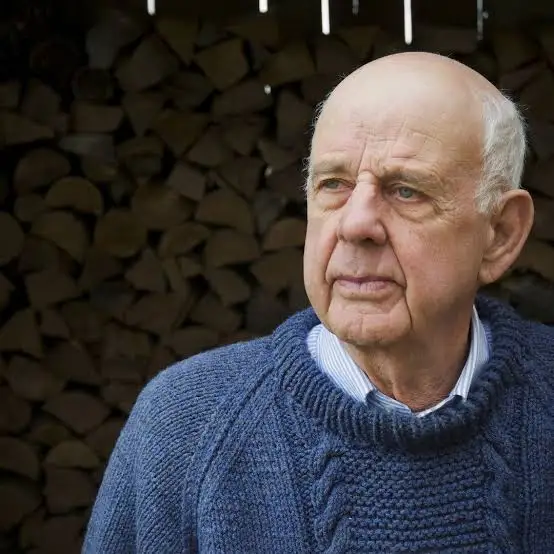
On 31 August this year, the official spokesperson for the Mad Farmer Liberation Front, signed off for the last time.
I am sure that, like me, many in the deep ecology community around the world – who knew and loved at least one poem of Wendell’s – wish for him the peace of wild things. May he find rest and freedom in the grace of the world.
When despair for the world grows in me
and I wake in the night at the least sound
in fear of what my life and my children’s lives may be,
I go and lie down where the wood drake
rests in his beauty on the water, and the great heron feeds.
I come into the peace of wild things.
I, too, came to Wendell’s poetry through my love and practice of deep ecology. I feel inadequate to pen a valediction for him in many ways, not least in that I am not familiar with all of his prodigious output of novels, short stories, poetry, essays and articles – more than 40 publications over nearly 70 years. Such a legacy to leave the world.
In Wendell’s poetry that I do know, I am bathed not only in the fragrance of Lane’s Landing, Henry County, Kentucky – his place on Earth – but also in a specific era, a time whose gifts I fear we are losing from Earth.
It brings to me my own grandfather, old Tom, and his love of simple things - soil, gardening, providing for his family, making do, repairing what was broken, praying to his Lord. It brings me a time when joy meant slurping your sweet, milky tea from the saucer where you’d tipped it, not so much to cool it down, but to get a rise from Tango, my grandmother, a strategy that never once failed.
Like old Tom, Wendell too would admit no screen or computer in his house. I share with Wendell the habit of writing poetry by pencil onto clean white paper, and I like to imagine that it was for the same reason – the sheer aesthetic pleasure of the act. Or perhaps it is that tangibility matters to those who stand by their words?
As a self-styled mad farmer, Wendell also brings to me Australia’s own Les Murray, who also returned, later in life, to his natal farm, far from Lane’s Landing in Bunyah, rural NSW. Les’ poetry always had a whiff of bull-dust about it, levened by the irreverent dry wit that he shared with Wendell and pretty much every farmer I’ve known. Maybe they are all poets? Story-tellers anyway. Les’ Homage to the Launching Place (aka, beds):
Resisting gravity, for us and in us,
you form a planet-wide
unobtrusive discontinuous platform,
a layer: the mattressphere,
pretty nearly our highest common level
(tables may dispute it).
But Les was a conservative, and no-one will accuse Wendell of that. His mad farmer mocks:
Love the quick profit, the annual raise,
vacation with pay. Want more of everything ready-made. Be afraid
to know your neighbours and to die…
When they want you to buy something
they will call you. When they want you
to die for profit they will let you know.
His manifesto?
…every day do something
that won’t compute. Love the Lord.
Love the world. Work for nothing.
Take all that you have and be poor.
Love someone who doesn’t deserve it…Put your faith in the two inches of humus
that build under the trees
every thousand years…Expect the end of the world. Laugh.
Laughter is immeasurable. Be joyful
though you have considered all the facts.
Mostly, when I think of Wendell, I think of a place. It’s green, part forested and part fields, with stone fences, livestock, and well-oiled gates. The homestead is old, built by an ancestor, freshly painted and deeply inhabited.
Wendell is one who took Gary Snyder’s advice: Stop somewhere. And found, as did Mary Oliver, that:
…wanting life
Implores no novelty and no disguise of distance…O, I go to see the great ships ride from harbor,
And my wounds leap with impatience; yet I turn back
To sort the weeping ruins of my house:
Here or nowhere I will make peace with the fact.
As a farmer, he learned from nature and from experience:
I go by a field where once
I cultivated a few poor crops.
It is now covered with young trees,
for the forest that belongs here
has come back and reclaimed its own.
And I think of all the effort
I have wasted and all the time,
and of how much joy I took
in that failed work and how much
it taught me. For in so failing
I learned something of my place,
something of myself, and now
I welcome back the trees.
Place was the very core and foundation of Wendell’s understanding of the world. He felt that:
…what people have to experience - have to let themselves experience - is the knowledge and understanding and even happiness that come with long association with people and places and kinds of work.
And this is what connects his work to deep ecology. The sense that while Earth comes first, this gives rise to – and never competes with – love, respect for others, and community. The sense that the neoliberal narcissism of modernity is simply wrong, sacrificing what has genuine worth and value for the profit of the few. The sense that hope is at once impossible and indispensable. The sense that gratitude is something that lives deep within us, and which is called forth by the inherent transience, and cyclical resilience, of life and of beauty:
Shall we do without hope? Some days
there will be none. But now…
they come again, the first
flowers of the year, the assembly
of the faithful, the beautiful,
wholly given up to being.And in this long season
of machines and mechanical will
there have been small human acts
of compassion, acts of care, work
flowerlike in selfless loveliness.Leaving hope to the dark
and to a better day,
receive these beauties freely
given, and give thanks.
Not only flowers, but also humanness – small human acts of compassion – can provide relief from the long season of the mechanical will. This is hope, even after we have considered all the facts.
In Wendell’s poetry, hope is never facile, nor is it separate from the work we are here to do in the world. Here he speaks to us with Tao-like clarity:
It may be that when we no longer know what to do
we have come to our real work
and that when we no longer know which way to go
we have come to our real journey.
The mind that is not baffled is not employed.
The impeded stream is the one that sings.
And in the assembly of the faithful, wholly given up to being, do we not hear echoes of Mary Oliver’s stalwart roses?
“Wild roses,” I said to them one morning,
“do you have the answers? And if you do,
would you tell me?”The roses laughed softly. “Forgive us,”
they said. “But as you can see, we are
just now entirely busy being roses.”
Roses as teachers. Earth as teacher. Place as teacher.
This is wisdom and the joy of Wendell Berry.
That in our service to Earth, we are called to work flower-like in selfless loveliness.
With love,
Philip Harrington
Read more: Profile: Wendell Berry, with quotes and a bibliography.