
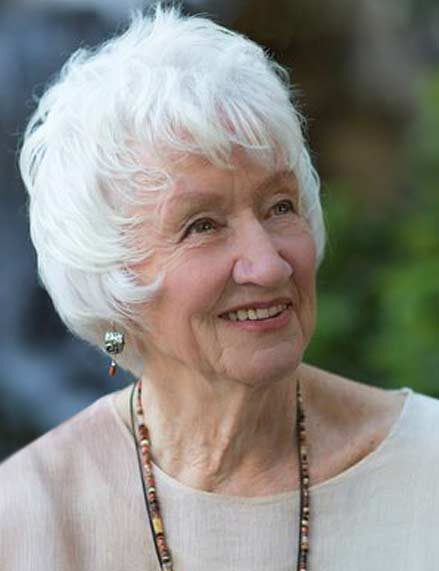
Elisabet Sahtouris is an American and Greek evolution biologist, futurist, and author whose work emphasises how cooperation and symbiosis, rather than competition alone, drive evolutionary processes. Similarly to Lynn Margulis, her research on living systems theory offers scientific foundations for ecological worldviews that recognize nature’s inherent cooperative and self-organizing aspects.
Trained in evolution biology and microbiology, Sahtouris has dedicated her career to making evolutionary science accessible to wider audiences while revealing its implications for human society and economics. Her concept of “mature ecosystems” proposes that natural systems evolve from competitive to cooperative relationships, offering models for sustainable human civilization.
Through books like “EarthDance: Living Systems in Evolution” and “Biology Revisioned” (co-authored with Willis Harman), Sahtouris bridges scientific understanding with indigenous wisdom traditions. She suggests that ancient cultures’ holistic perspectives align with contemporary systems biology, validating ecological knowledge that Western science is only now rediscovering.
As a consultant to businesses and government agencies worldwide, Sahtouris applies evolutionary principles to organizational and economic systems. Her work proposes that human systems can mature from extractive to regenerative models by following natural patterns of sustainable development.
Her integration of rigorous biology with accessible communication and practical application is an example of scientific understanding in service of ecological awakening that values both empirical knowledge and traditional wisdom.
Key Concepts
- Living Systems Evolution: Natural systems evolve from competitive to cooperative relationships over time
- Mature Ecosystems: Advanced ecosystems demonstrate cooperation, symbiosis, and regeneration rather than competition
- Evolutionary Economics: Economic systems can mature by following nature’s patterns of sustainable organization
- Biology and Indigenous Wisdom: Scientific validation of traditional ecological knowledge and holistic worldviews
- Gaia Theory: Earth as self-organizing living system, extending Lovelock and Margulis’s work
Essential Works
- “EarthDance: Living Systems in Evolution” (1989, 2000)
- “Biology Revisioned” (with Willis Harman, 1998)
- “A Walk Thru Time: From Stardust to Us” (1998)
- “Gaia’s Dance: The Story of Earth & Us” (2017)
Quotes from Elisabet Sahtouris
A theme Sahtouris returns to across several of her essays: species evolve from a competitive, acquisitive early phase toward a cooperative, mature one — and she argues human civilisation is due for the same maturation, from a “youthful competitive phase” toward a “mature cooperative phase.” (Several other lines previously attributed to her here couldn’t be verified against her published essay archive or her books’ catalogued quotes, and have been removed rather than left uncited.)
Further Reading
Biographical Sources
- Official Website - Writings, lectures, and biographical information
- Wikipedia: Elisabet Sahtouris - Overview of life and work
Key Books
- EarthDance: Living Systems in Evolution (Simon & Schuster 1989; iUniverse 2000)
- Biology Revisioned with Willis Harman (North Atlantic Books 1998)
- Gaia’s Dance: The Story of Earth & Us (Amazon 2017; French edition Paris 2016)
Articles & Lectures
- Ratical.org archive - Extensive collection of essays and talks
- Various sustainability conferences and business consultancy work