
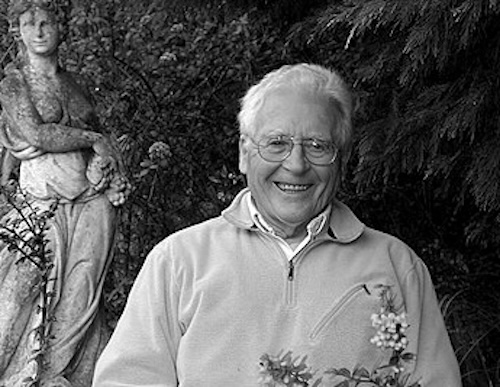
James Ephraim Lovelock (1919-2022) was an independent scientist who formulated the Gaia hypothesis in the early 1970s. Working outside academic institutions, he proposed that Earth functions as a self-regulating system through interactions between living organisms and planetary processes.
Lovelock invented the electron capture detector in 1957, which enabled the first measurements of widespread chlorofluorocarbons in the atmosphere. While designing instruments for NASA’s planetary exploration programs in the 1960s, he developed the conceptual framework that became the Gaia hypothesis.
The Gaia hypothesis, first presented in 1972, proposes that Earth’s living organisms interact with inorganic systems to maintain conditions suitable for life. Lovelock developed this theory in collaboration with microbiologist Lynn Margulis throughout the 1970s. The hypothesis suggests that life actively influences planetary conditions - atmosphere, oceans, and surface geology - rather than merely adapting to them.
Lovelock’s research examined how Earth’s temperature, atmospheric composition, and ocean salinity have remained relatively stable over billions of years despite changes in solar output and other factors. He proposed that this stability results from regulation by the biosphere itself, analogous to physiological regulation in organisms. His Daisyworld computer model (1983) demonstrated how simple organisms could regulate planetary temperature through feedback mechanisms.
In later work, Lovelock advocated for nuclear energy as a response to climate change and proposed climate engineering solutions. His books, including Gaia: A New Look at Life on Earth (1979) and The Ages of Gaia (1988), presented his theories to wider audiences. He continued writing and conducting research until shortly before his death at age 103.
Key Concepts
- Gaia Hypothesis (1972): Earth as self-regulating system maintaining conditions suitable for life through biosphere interactions
- Planetary Homeostasis: Regulation of Earth’s temperature, atmosphere, and chemistry by biological processes
- Daisyworld (1983): Computer model demonstrating planetary temperature regulation through biological feedback
- Earth System Science: Integration of biological, chemical, and physical processes in planetary function
- Independent Science: Scientific work conducted outside institutional frameworks
Essential Works
- “Gaia: A New Look at Life on Earth” (Oxford University Press, 1979) - ISBN 978-0-19-217665-3
- “The Ages of Gaia: A Biography of Our Living Earth” (W.W. Norton, 1988) - ISBN 978-0-393-02583-5
- “Gaia: The Practical Science of Planetary Medicine” (Oxford University Press, 2000) - ISBN 978-0-19-521674-5
- “The Revenge of Gaia” (Basic Books, 2006) - ISBN 978-0-465-04168-4
- “The Vanishing Face of Gaia” (Basic Books, 2009) - ISBN 978-0-465-01549-8
Further Reading
Biographical Sources
Key Books
- Gaia: A New Look at Life on Earth (Oxford University Press, 1979) - ISBN 978-0-19-217665-3
- The Ages of Gaia (W.W. Norton, 1988) - ISBN 978-0-393-02583-5
- The Great Extinction with Michael Allaby (Doubleday, 1983) - ISBN 978-0-385-18011-5
Scientific Papers
- “The Quest for Gaia” with S. Epton, New Scientist 65(935): 304 (1975)
Related Resources
- Collaboration with Lynn Margulis documented in scientific literature
- Gaia theory’s influence on earth system science