
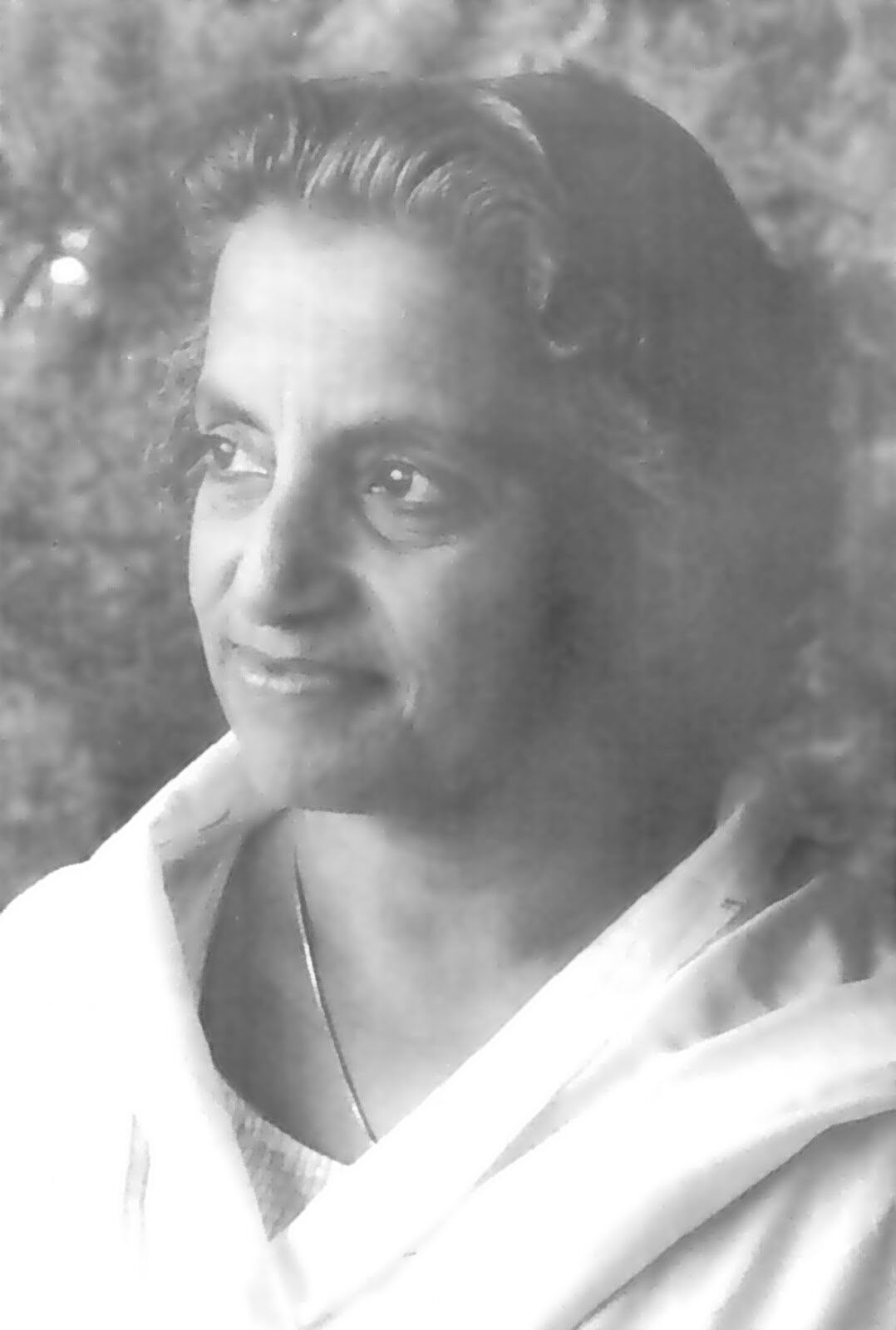
Vimala Thakar (1921-2009) was an Indian philosopher, social activist, and spiritual teacher who pioneered the integration of meditative inquiry with social justice work. A woman who challenged the norms of Indian spiritual and political life in the mid-20th century, she proposed that inner transformation and outer action are inseparable dimensions of human wholeness.
Influenced by both Gandhian philosophy and the teachings of J. Krishnamurti, Thakar developed an approach to spiritual life that rejected the traditional separation between contemplation and social engagement. She argued that becoming a spiritual inquirer without social consciousness is a “luxury we can ill afford,” while social activism without understanding the inner workings of mind represents “the worst folly.”
Thakar’s work with land reform movements and her advocacy for marginalized communities demonstrated this integration in practice. She taught that awareness of wholeness naturally leads to compassionate action, as recognition of interconnection dissolves the artificial boundaries between self and other, inner work and outer change.
Her approach to meditation emphasized totality rather than technique, proposing that genuine awareness transforms both individual consciousness and social relationships. This vision of spirituality as inseparable from social responsibility influenced activists and contemplatives worldwide, including deep ecologists like John Seed, who studied with her and brought her teachings on nonviolent direct action to environmental movements.
Key Concepts
- Integration of Inner and Outer: Spiritual inquiry and social activism as inseparable dimensions of wholeness
- Totality of Living: Expanding understanding to global scale, integrating all dimensions of human experience
- Awareness of Wholeness: Recognition that all beings are interconnected, transforming both consciousness and action
- Satyagraha: Gandhian “truth force” - nonviolent resistance through spiritual and moral power
- Sacred Activism: Every action becomes sacred when arising from awareness of the whole
Essential Works
- “On an Eternal Voyage” (Vimala Programs California, 1966)
- “Totality in Essence” (Motilal Banarsidass, 1986) - ISBN 978-8120801820
- “The Eloquence of Living” (Vimala Thakar Foundation, 1989)
- “Spirituality and Social Action: A Holistic Approach” (Various editions)
Quotes from Vimala Thakar
Further Reading
Biographical Sources
- Wikipedia: Vimala Thakar - Life and teachings overview
- In the Fire of Dancing Stillness - Documentary film about her life
Key Books
- Totality in Essence (Motilal Banarsidass, 1986) - ISBN 978-8120801820
- On an Eternal Voyage (Vimala Programs California, 1966)
- The Eloquence of Living (Vimala Thakar Foundation, 1989)
Related Resources
- Vimala Thakar Foundation archives
- Teachings on Gandhian philosophy and nonviolent action
- Connection to J. Krishnamurti’s teachings on meditation and inquiry